The single decision that determines whether a crossbody bag gets worn daily or abandoned in a closet is size. Get it right and the bag disappears into your routine; get it wrong and you are either cramming essentials into a pouch or hauling a half-empty sack. Before you choose a print, a color, or a strap hardware finish, settle the dimensions and the fit. This guide walks through how to match a custom crossbody bag to real use, from interior capacity to strap length to the material that suits how the bag will actually live.
Match the size class to what you actually carry
Crossbody bags sort into four rough size classes, and each maps to a different daily load. Mini bags run about 5 to 7 inches wide and 4 to 6 inches tall. They hold a phone, a few cards, and a lip balm, and nothing more. They suit concerts, festivals, and coffee runs where you want your hands free and your load light. Small bags, roughly 7 to 9 inches wide and 6 to 8 inches tall, are the everyday workhorse: phone, full wallet, keys, and a compact makeup item fit without strain.
Medium bags step up to about 9 to 11 inches wide and 8 to 10 inches tall, enough for a small tablet, a slim notebook, and a water bottle, which makes them the natural pick for work commutes or day trips. Large bags span 11 to 14 inches wide and 10 to 12 inches tall and will swallow a 13-inch laptop, travel documents, and a change of clothes. The tradeoff is bulk: a large crossbody worn across the body all day pulls on the shoulder in a way a mini never will. The chart below shows the typical width and height for each class so you can picture the footprint before committing.
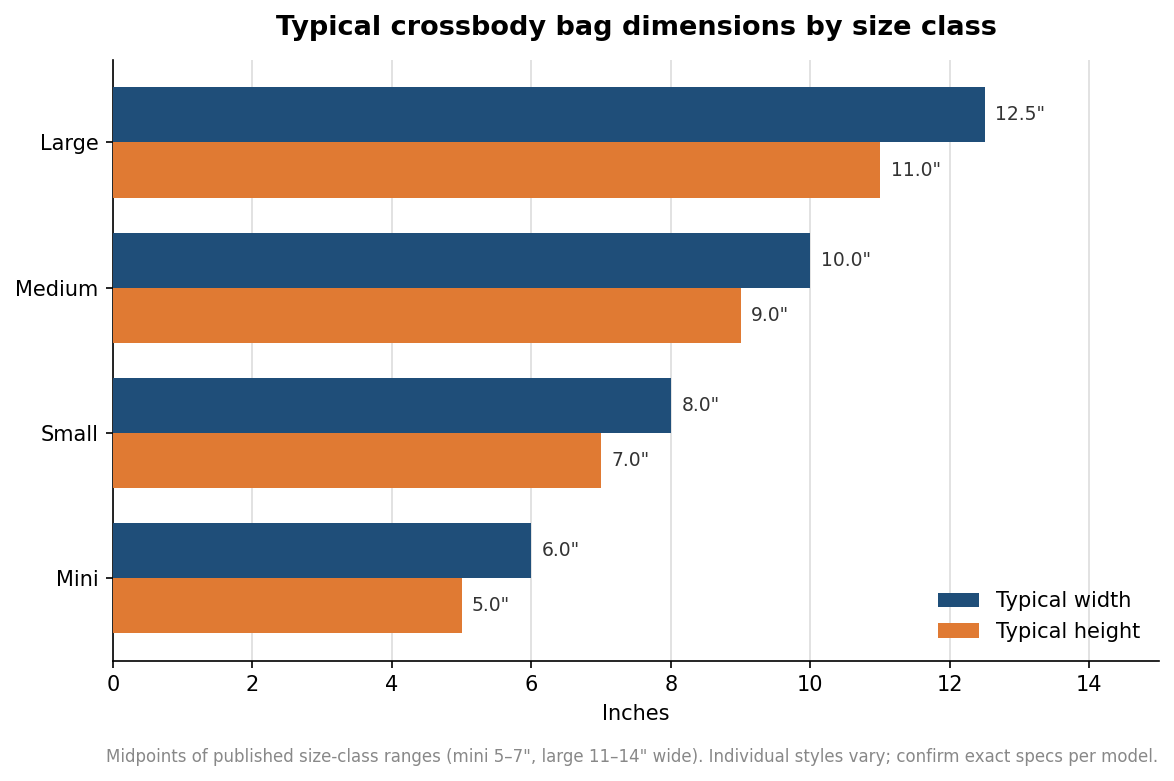
These figures are midpoints of published size ranges rather than fixed standards, so always confirm the exact measurements of the specific style you are customizing. If you are deciding between two classes, think about the largest item you carry regularly, not the smallest. A bag that fits your tablet on the one day a week you need it is more useful than one that never does.
Strap length is the other half of the fit
Dimensions decide what goes inside; strap length decides how the bag sits on the body. A well-chosen size still fails if the strap rides too high under the arm or hangs past the hip. Adjustable straps solve most of this, and the useful ranges cluster into four bands. A petite or close fit uses roughly 20 to 24 inches of total strap length and keeps the bag high on the torso. A standard adult fit lands around 24 to 30 inches, placing the bag near the hip. Taller wearers or anyone who wants a lower, relaxed drop need 30 to 36 inches, and an extra long band of 34 to 40 inches suits layering over coats or wearing the bag low and casual.
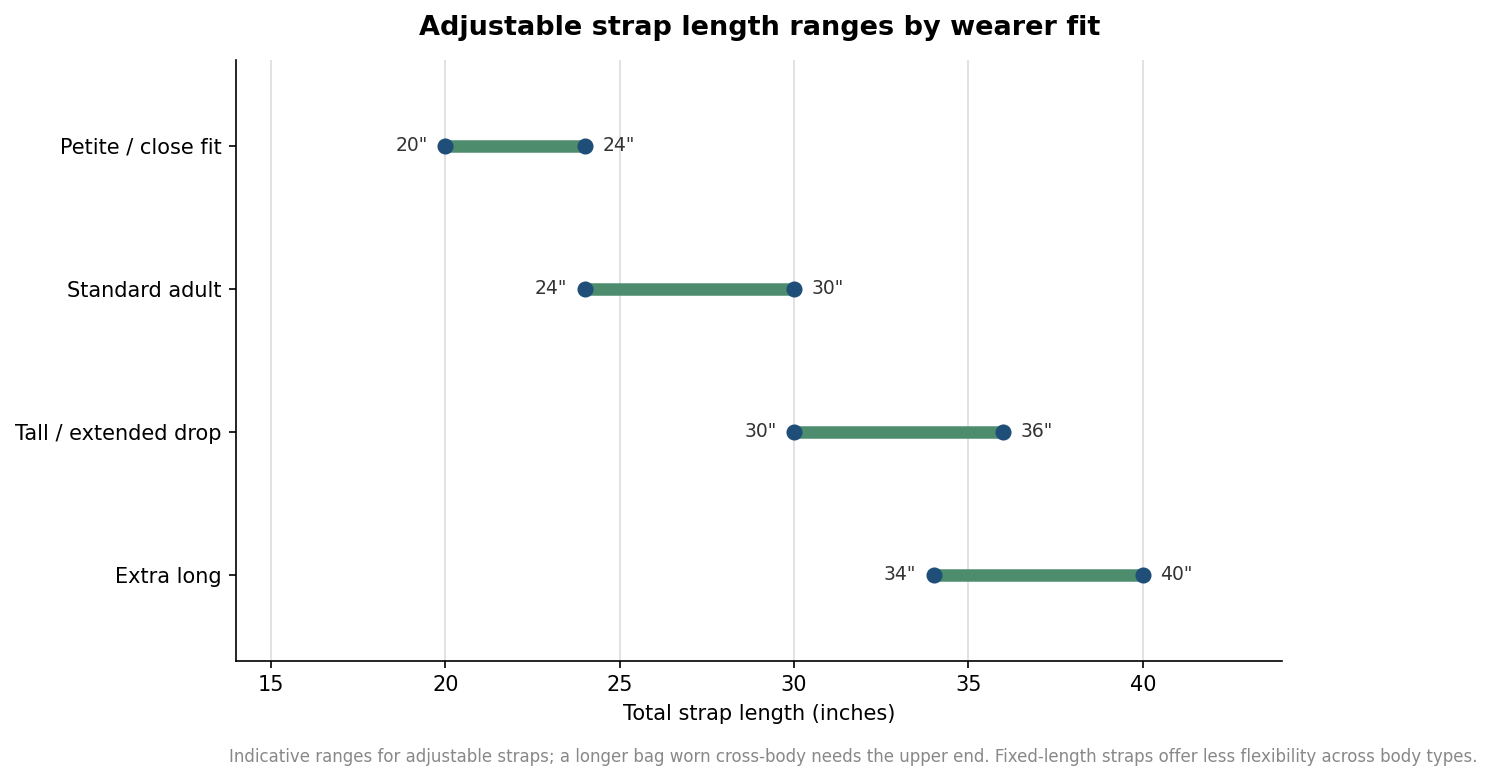
When you specify a custom bag, favor an adjustable strap with a wide travel range over a fixed length. A fixed strap is cheaper and cleaner-looking, but it forces every wearer into one drop height, which is a problem if the bag is a gift, a team uniform piece, or a retail product meant for a range of body types. If the design must use a fixed strap, size it for the middle of your intended audience and accept that the extremes will compromise.
Choose the material for how the bag will be used
Material affects weight, water resistance, durability, and, critically, which decoration methods will reproduce your artwork cleanly. Nylon and polyester are lightweight and easy to make water-resistant, which is why they dominate travel and everyday functional bags; they also take dye-sublimation printing well, letting you run edge-to-edge, full-color graphics that will not crack or peel. Canvas and cotton read casual and eco-minded and are best decorated with screen printing, embroidery, or a woven label rather than photographic prints.
PU and vegan leather give a structured, premium look at a lower cost than hide, and they pair best with embossing, debossing, or a metal logo plate; printed graphics on these surfaces can look flat and are more prone to wear at stress points. Genuine leather ages attractively and justifies a higher price, but it is the least forgiving to customize and the hardest to keep consistent across a production run. Decide the decoration method and the material together, because a full-color logo that sings on sublimated polyester will disappoint as a heat transfer on grained PU.
Plan quantities, lead times, and proofs before you order
Custom bag production carries real constraints that are worth understanding up front. Minimum order quantities depend heavily on how custom the bag is: a semi-custom bag that decorates an existing blank has a far lower minimum than a fully bespoke design with custom patterns, hardware, and linings. As a rough planning rule, expect decorated blanks to be available in smaller runs while ground-up custom development requires committing to larger quantities to justify tooling and setup. Confirm the exact minimum with your supplier before you design, because it shapes what is economically sensible.
Build in time for a physical proof or pre-production sample before the full run. A digital mockup confirms layout, but only a sample confirms how the print sits on the actual weave, how the color shifts on the real substrate, and whether the strap and zippers feel right. Approving a sample is the cheapest insurance against a run of bags that are technically correct and practically wrong. Treat lead times as indicative until your supplier quotes your specific job, since material sourcing, decoration method, and quantity all move the timeline.
Work the decision in order: figure out the load, pick the size class, set the strap range, then choose a material and decoration method that fit both the look and the print. A crossbody bag that nails those four things becomes the one that leaves the house every day, which is the only real measure of whether the customization was worth it.