Two crossbody bags can look identical on a product photo and behave nothing alike in a customer’s hands. The difference is almost always the material: the fabric of the shell, the coating behind it, the hardware at the stress points, and the decoration method that puts your logo on the front. If you are ordering custom crossbody bags in any quantity, understanding those inputs is what lets you match the bag to the job instead of guessing from a swatch. This is a working deep-dive into what these bags are actually made of and how each choice changes the result.
Denier is the number that decides durability
Most technical bag fabrics are described by a denier rating, written as a number followed by “D,” such as 210D or 600D. Denier measures the thickness of the individual yarns woven into the fabric, and as a rough rule, a higher denier means a heavier, more abrasion-resistant, more structured cloth. It is not a perfect proxy for quality because weave density and coating matter too, but it is the single most useful shorthand a buyer has. The trade-off is always durability against weight. A bag that survives years of daily abuse also sits heavier on the shoulder, and for a crossbody worn against the body all day, that weight is felt.
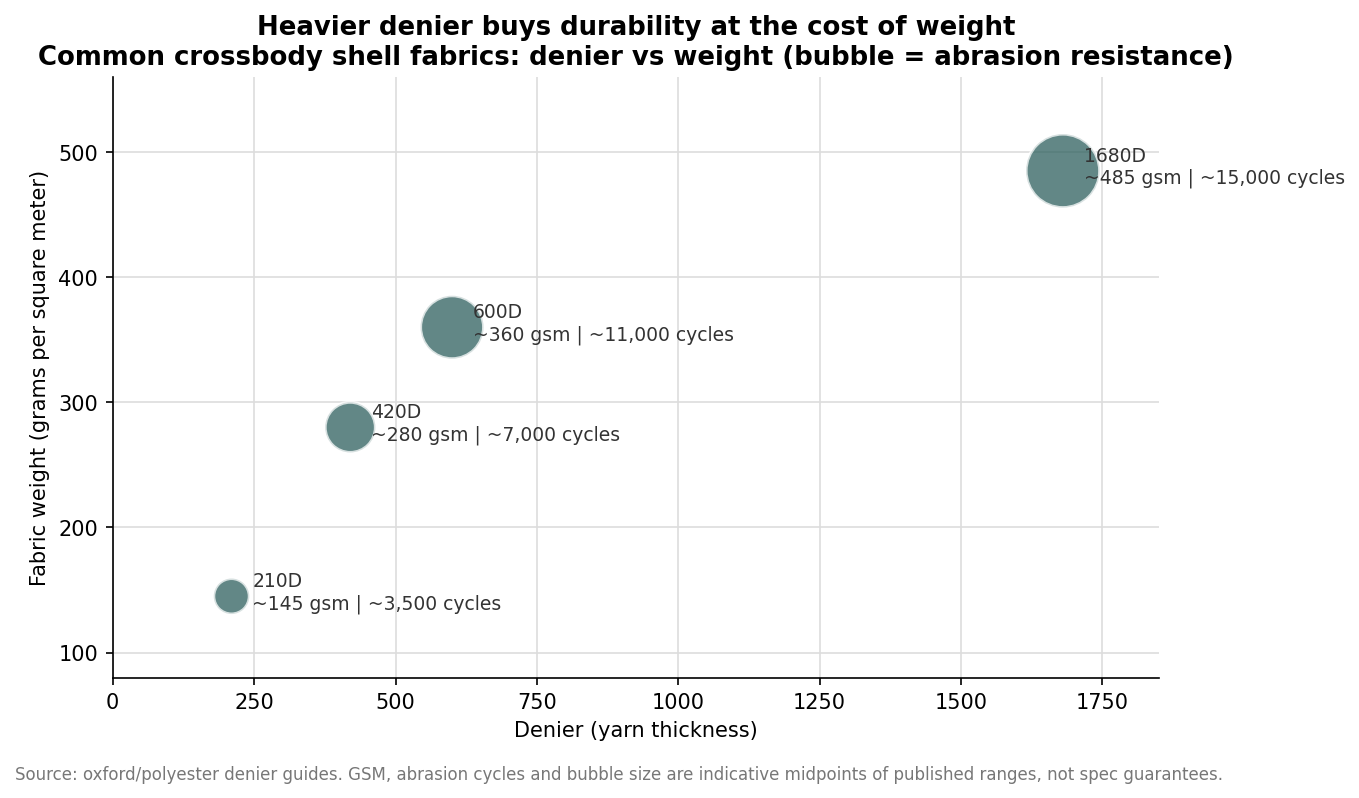
In practice, four deniers cover most of the crossbody market. A 210D fabric is light and soft, typically around 110 to 180 grams per square meter, and it belongs in linings, packable bags, and pocket panels rather than an outer shell that takes daily wear. A 420D fabric, usually in the 260 to 300 gram range, is the sweet spot for everyday bags that need to feel substantial without turning stiff. A 600D fabric, roughly 340 to 380 grams, is the industry workhorse: it holds its shape, resists years of contact, and coats well for water resistance. A 1680D ballistic fabric is heavy-duty to the point of being overkill for most crossbodies, and well-designed bags tend to place it only at corners and bases rather than across the whole body. The chart below maps these fabrics by weight and abrasion resistance so the trade-off is visible at a glance.
Nylon, polyester, canvas, and the coating behind them
Denier describes the yarn, but the fiber matters too. Polyester is the default for promotional and mid-market bags because it holds printed color well, resists UV fading, and costs less. Nylon of the same denier is generally stronger and more abrasion-resistant, with a softer hand, which is why it shows up in premium and outdoor-leaning bags, though it can absorb more water unless treated. Cotton canvas is a different animal entirely, sold by ounce weight rather than denier, with 6 to 16 ounces per square yard covering everything from light totes to structured bags; a 6-ounce canvas gives that natural, casual look many lifestyle brands want. Recycled polyester, often labeled RPET and frequently made from 50 percent or more post-consumer material, has become common and lets a bag carry a sustainability story without a meaningful drop in performance.
Water resistance rarely comes from the fabric alone. It comes from a coating applied to the back, usually polyurethane or TPU, plus how the bag is built. A “water-resistant” bag and a “waterproof” bag are not the same claim. Most crossbody bags are water-resistant: the coated fabric and a rain flap over the zipper shed a shower, but seams and zipper teeth are still entry points. True waterproofing requires sealed or welded seams and a proper waterproof zipper, which adds cost and stiffness most everyday bags do not need. When a supplier quotes water resistance, it is worth asking specifically whether they mean a coated fabric, a covered zipper, or fully sealed construction, because those are three different levels of protection.
The hardware quietly determines how long it lasts
Fabric gets the attention, but crossbody bags usually fail at the hardware first. The zipper is the most-used moving part, and a smooth, branded zipper from a reputable maker is one of the clearest tells of a quality bag; a cheap zipper that separates or jams ends the bag’s life regardless of how good the cloth is. The strap connection points, the swivel hooks, D-rings, and slider that let a wearer adjust the drop, take constant load and should be metal on anything meant to last, with plastic acceptable only on lightweight, low-cost pieces. Stitching at the strap anchors is the other common failure point, and reinforced bar-tacking there is worth confirming. None of this shows up in a catalog photo, which is exactly why it is worth writing into a spec.
Decoration changes cost more than you expect
How your logo goes onto the bag affects both the look and the economics of the order, and the biggest surprise for first-time buyers is usually the up-front setup cost. Screen printing lays down durable, opaque ink and is economical at volume, but it charges a setup fee per color, so a three-color logo carries three setup charges before a single bag is printed. Embroidery reads as premium and holds up to washing and abrasion better than almost anything, but it requires a one-time digitizing fee to convert your artwork into a stitch file, and it is best for logos rather than fine detail or gradients. Heat transfer and DTF printing carry very low setup and reproduce full-color artwork cleanly, which makes them ideal for small runs and complex graphics, at the cost of a print that sits on the surface rather than in the fabric. Dye sublimation produces vivid, permanent, full-bleed color but works only on polyester and only on light backgrounds. The chart below shows where the one-time setup cost lands for each method.
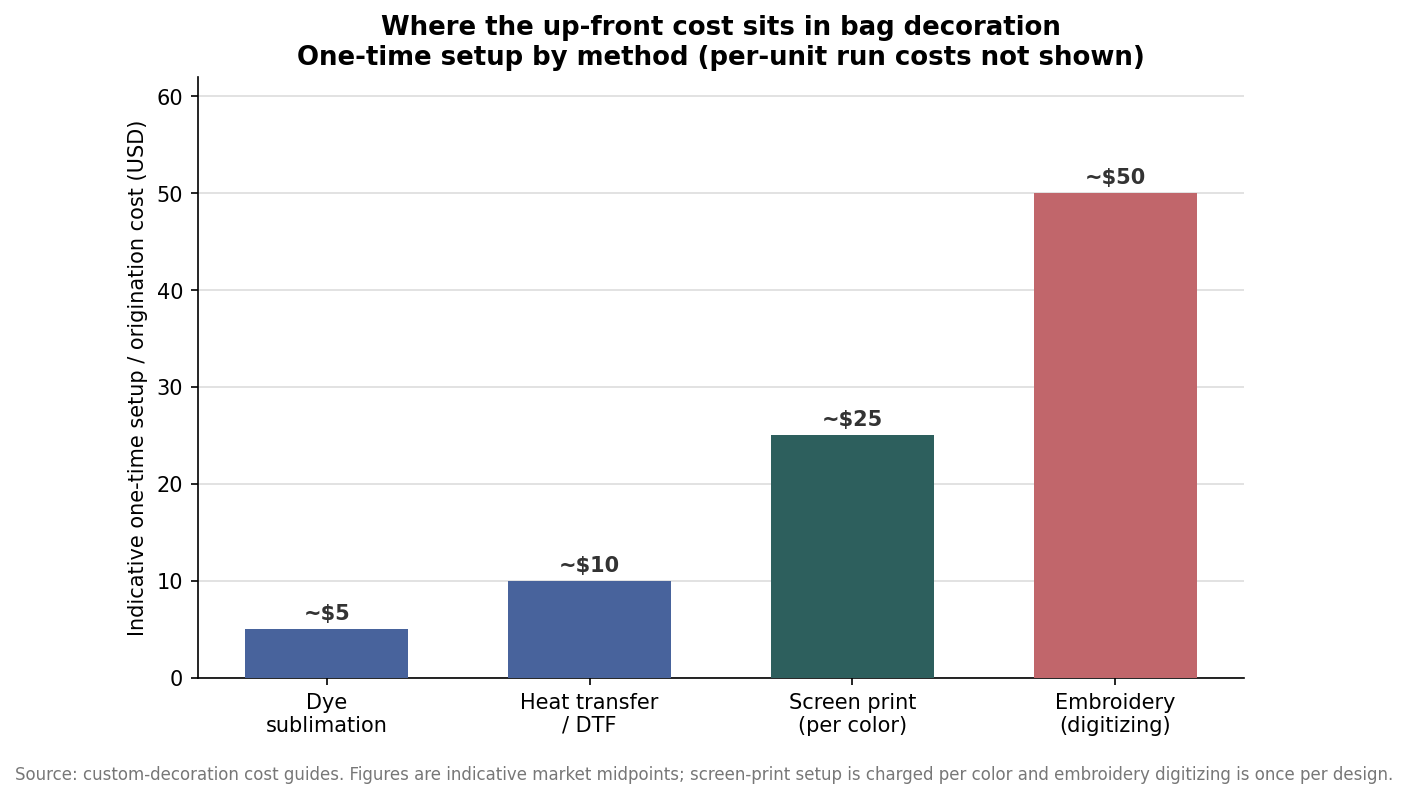
The practical reading of that chart is that method should follow order size and artwork. For a large run of a simple one or two-color logo, screen printing’s setup cost is amortized quickly and the per-unit price wins. For a small run, a photographic design, or a rush job, heat transfer or DTF avoids the setup entirely and gets you a clean full-color result. Embroidery is the choice when the bag needs to feel upscale and the logo is simple enough to stitch well. The figures shown are indicative market midpoints rather than quotes, and the per-unit decoration cost, which is not shown here, moves the total in the opposite direction as quantity climbs.
Specifying a bag you will be happy with
Put together, a good custom crossbody spec names five things: the shell fabric and denier, the coating or water-resistance level, the hardware grade at the zipper and strap points, the decoration method matched to your artwork and quantity, and the colorways. A 420D or 600D coated polyester body with metal strap hardware and a covered zipper covers the vast majority of everyday use cases at a sensible price, and you scale up to nylon or ballistic reinforcement only when the use case genuinely demands it. Decide those inputs before you request a quote, and the numbers you get back will actually be comparable across suppliers instead of a pile of look-alike photos at look-alike prices.